




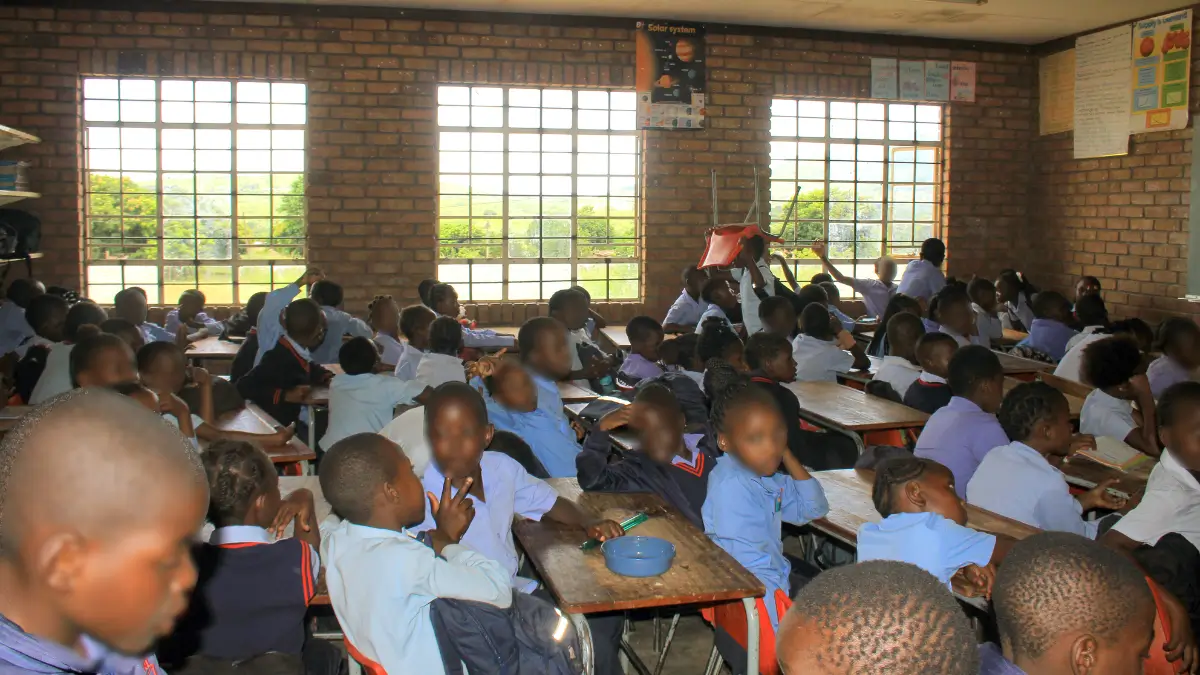
Nearly half of Gauteng’s public schools are now operating beyond capacity, with more than 1 000 institutions exceeding their intended limits as enrolment continues to rise. The Gauteng schools crisis affects over 2.8 million pupils across the province and is most severe at secondary school level, where space shortages are growing.
Education authorities warn that the situation could impact learner placement for the 2027 academic year, particularly in high-pressure districts. The latest data highlights mounting strain on infrastructure, staffing and resources, with Gauteng’s rapid population growth outpacing the delivery of new schools.
ALSO READ: Gauteng Load Reduction Schedule 27–30 April 2026: Full Timetable By Area and Block
Scale of The Crisis: More Than 1 000 Schools Overcrowded
Gauteng’s education system is facing sustained pressure driven by population growth and migration into the province.
According to provincial figures:
- 1 021 out of 2 111 schools are operating above capacity
- This represents 48% of all public schools
- The total learner population has reached 2.8 million
- Enrolment increases by approximately 50 000 learners annually
The scale of overcrowding reflects long-term infrastructure constraints rather than short-term demand spikes.
Secondary Schools Under The Greatest Pressure
The crisis is most acute at secondary school level, where capacity shortages continue to widen.
Key data shows:
- 64% of secondary schools are overcrowded
- Compared to 41% of primary schools
- A shortfall of 88 088 secondary school places currently exists
- Primary schools still reflect a surplus of over 54 000 spaces
This imbalance highlights a structural gap in Gauteng’s schooling system, where progression from primary to secondary level is not adequately supported by available infrastructure.
Mismatch in School Infrastructure Driving The Problem
Gauteng has significantly more primary schools than secondary schools:
- 1 417 primary schools
- 694 secondary schools
This disparity means that as learners move through the system, there is insufficient capacity to accommodate them at high school level.
Education MEC Lebogang Maile said this imbalance is contributing directly to overcrowding pressures, describing the system as constrained by both historical inequalities and current fiscal limitations.
Districts Hardest Hit by Overcrowding
Overcrowding is widespread across Gauteng, but some districts are more severely affected than others.
The most impacted areas include:
- Johannesburg South: 68% of schools overcrowded
- Tshwane West: 68%
- Johannesburg East: 59%
- Ekurhuleni South: 58%
- Tshwane South: 56%
By contrast:
- Johannesburg Central: 29%
- Johannesburg North: 35%
Authorities describe the crisis as systemic, affecting nearly all districts rather than isolated areas.
Township Growth and Urban Migration: Increasing Demand
Rapid urbanisation continues to drive demand for schooling across Gauteng.
Key contributing factors include:
- Ongoing migration into Gauteng as an economic hub
- Expansion of townships and informal settlements
- Residential development outpacing school construction
High-density areas, particularly in metros such as Johannesburg, Tshwane and Ekurhuleni, are experiencing the greatest pressure.
Teacher Shortages and High Learner Ratios
Overcrowding has also impacted classroom conditions and teaching capacity.
- The current learner-teacher ratio is estimated at 70:1
- This exceeds the recommended 40:1 ratio
High ratios affect teaching quality, learner engagement and overall academic performance.
Furniture Shortages Highlight Infrastructure Strain
The overcrowding crisis extends beyond classroom space to basic resources.
According to the 2026 school readiness audit:
- Primary schools lack:
- 67 855 chairs
- 25 990 double desks
- Secondary schools lack:
- 111 333 chairs
- 98 115 single desks
The shortages are linked to both rising enrolment and damage or loss of existing infrastructure.
Infrastructure Delivery Challenges Slowing Progress
Efforts to build new schools are being hindered by systemic challenges.
Authorities have identified several key issues:
- Delays in construction and project delivery
- Poor contractor performance
- Vandalism and disruption at construction sites
- Land constraints, including dolomitic conditions
- Rising infrastructure costs
These factors have limited the province’s ability to respond quickly to increasing demand.
Plans To Address The School Shortage
The Gauteng Department of Education has outlined several interventions.
Current plans include:
- A R3.98 billion infrastructure budget over the medium term
- Construction of approximately 7 new schools per year
- Partnerships with the Development Bank of South Africa
- Development of 18 greenfield school projects
Additional measures being explored:
- Public-private partnerships
- Reopening previously closed schools
- Acquisition of former mission schools
- Deployment of temporary prefabricated classrooms
Despite these efforts, the scale of demand continues to exceed delivery capacity.
What This Means for Gauteng Residents
The overcrowding crisis has direct implications for families across the province.
For residents, this means:
- Increased competition for school placement, especially at secondary level
- Potential delays in learner placement ahead of the 2027 academic year
- Larger class sizes and reduced individual attention
- Ongoing pressure on education quality and resources
The issue affects both access to education and the overall learning environment.
FAQ: Gauteng Schools Overcrowding
How many schools are overcrowded in Gauteng?
1 021 out of 2 111 public schools are operating above capacity.
Which schools are most affected?
Secondary schools are most impacted, with 64% exceeding capacity.
Why is overcrowding happening?
The crisis is driven by population growth, migration, and insufficient infrastructure development.
How many additional schools are needed?
An estimated 83 new secondary schools are required to meet current demand.
Will this affect future school placements?
Yes. Authorities have warned that not all learners may be placed for the 2027 academic year in some districts.
What Happens Next
The Gauteng Department of Education is expected to continue rolling out infrastructure projects and partnerships to address the backlog. However, with enrolment growth continuing to outpace delivery, pressure on the system is likely to persist in the short to medium term.
Further updates are expected as planning for the 2027 academic year progresses, particularly in high-demand districts where capacity constraints remain most severe.
