




Johannesburg Water has intensified measures to protect the city’s water supply as forecasts of hotter and drier conditions linked to El Niño raise concerns about water availability. In a statement reported on Wednesday, 16 September 2026, the utility said it was managing reservoir levels, strengthening pressure controls and prioritising leak repairs across Johannesburg. The interventions aim to balance available water with demand while reducing losses from a supply system that is already under pressure.
The utility has also called on households to reduce unnecessary water use, warning that conservation will become increasingly important as the city prepares for potentially lower rainfall.
ALSO READ: Eskom Rooftop Solar Registration: What Homeowners Need to Know Before 30 September
Johannesburg Water introduces tighter supply management
Johannesburg Water said it is actively managing the supply network to ensure that available water is distributed as effectively as possible.
According to the utility, its response includes adjustments at reservoirs and pump stations, alongside restrictions in informal settlements where operational conditions require them.
These interventions are intended to balance water entering the system with the amount consumed by households, businesses and other users.
Reservoir management is particularly important when demand rises or incoming supply cannot keep pace with consumption. The utility’s measures seek to prevent available water from being depleted faster than the system can replenish it.
Johannesburg Water has not provided a complete list of affected areas or a timetable for the restrictions described in its statement. Residents should therefore not assume that every part of the city will experience the same interventions.
Pressure management and leak repairs receive attention
The utility said it is strengthening pressure management across its network to optimise available water and limit unnecessary losses.
Water pressure must be managed carefully because excessive pressure can contribute to losses through damaged infrastructure, while insufficient pressure can affect supply to consumers.
Johannesburg Water also said it is prioritising repairs to leaking pipes and burst infrastructure.
Its teams are addressing both previously reported incidents that remain unresolved and newly reported faults.
The utility said it is strengthening its initial response to operational problems so that teams can attend to incidents more quickly.
These measures address an immediate challenge for the city. Water lost through damaged pipes is water that cannot reach consumers, regardless of how carefully households manage their own consumption.
The statement did not specify how many outstanding leaks remain in the repair backlog or provide a deadline for clearing it.
Why El Niño is raising concerns about water supply
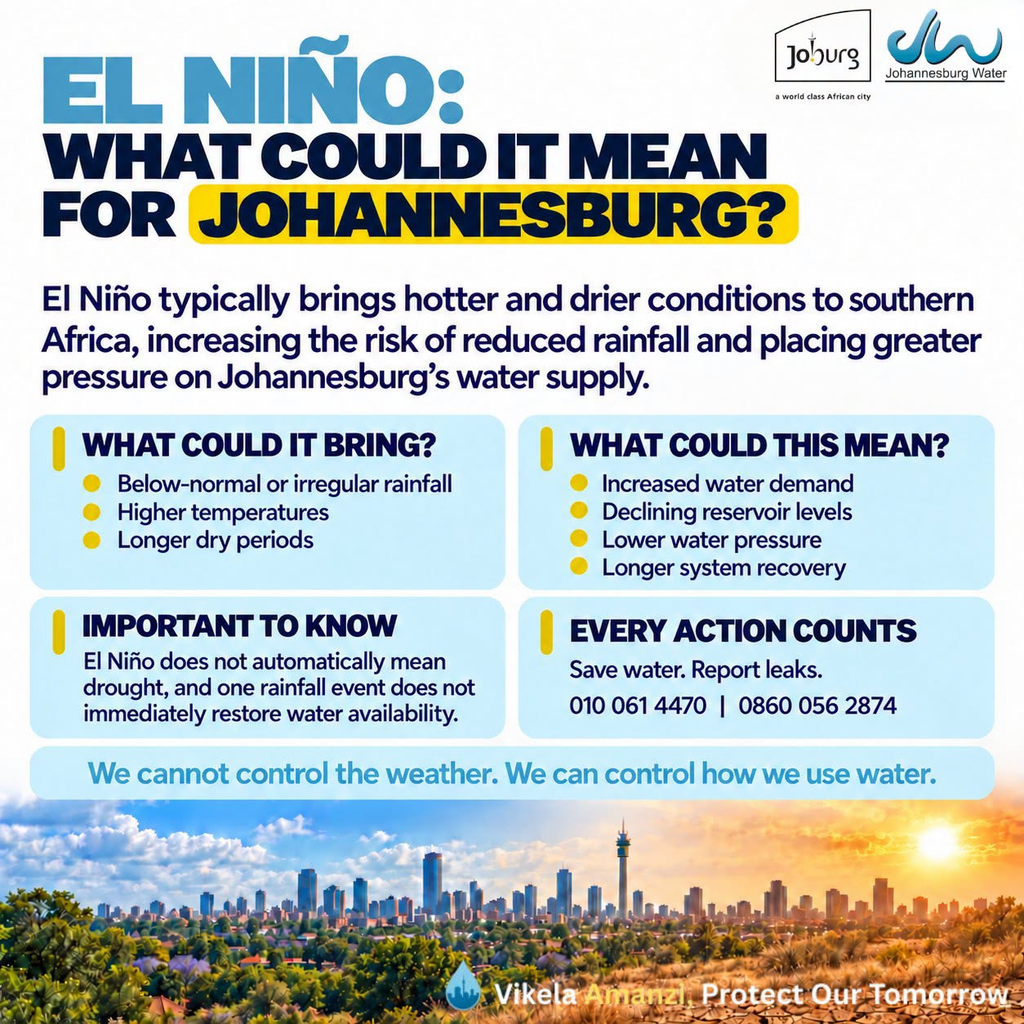
El Niño is a natural climate pattern involving changes in temperatures in the tropical Pacific Ocean that can influence weather across different regions.
In southern Africa, El Niño is often associated with hotter and drier conditions, although its effects vary between seasons and locations.
Johannesburg Water said the Department of Water and Sanitation had warned that the developing climate conditions could place additional pressure on already limited water resources.
According to the South African Weather Service, its seasonal forecast for October to December 2026 indicates that below normal rainfall is the most likely outcome across much of South Africa.
The weather service has also warned that the developing El Niño event could intensify.
These forecasts explain why water authorities are preparing ahead of the summer period. However, a seasonal rainfall forecast does not establish exactly how much rain Johannesburg will receive or determine when individual neighbourhoods might experience supply interruptions.
Actual water availability will depend on several factors, including rainfall, demand, infrastructure performance and the management of available resources.
Residents asked to reduce daily water consumption
Johannesburg Water has urged residents to take practical steps to reduce water use at home.
The utility identified several actions that households can take immediately:
- Repair leaking taps and pipes as soon as possible.
- Turn off taps when water is not being used.
- Water gardens only before 6am or after 6pm.
- Report water leaks and burst pipes so that they can be attended to.
According to Johannesburg Water, a running tap can waste up to six litres of water every minute.
This means leaving a tap running unnecessarily for five minutes could waste up to 30 litres, based on the utility’s estimate.
The utility said residents should treat water conservation as an ongoing responsibility rather than something that becomes necessary only during a shortage.
Household action can help reduce demand, but the utility’s statement also makes clear that infrastructure repairs and operational management remain part of its response.
What This Means for Gauteng Residents
The measures announced by Johannesburg Water directly concern people who live and work within the City of Johannesburg.
Residents may encounter supply adjustments in areas where the utility introduces restrictions or changes water pressure to manage available resources.
However, the statement does not establish that all Johannesburg households will face interruptions or that the same measures will apply across Gauteng.
For households, the immediate message is to monitor water use and address leaks that are within their control.
Businesses, schools and other facilities that depend on a consistent supply also have reason to follow official service notices, particularly if they operate in areas affected by reservoir or pump station interventions.
Residents should distinguish between the broader El Niño forecast and confirmed local service disruptions. A warning about possible dry conditions is not the same as an announcement that a particular suburb will lose water.
Johannesburg Water’s operational notices remain important for identifying confirmed disruptions, affected areas and any restoration estimates issued by the utility.
What residents should know about the coming summer
The latest measures form part of Johannesburg Water’s preparation for conditions that could increase pressure on the supply network.
Hotter weather can increase demand for water, particularly for activities such as garden watering. Below normal rainfall may also complicate efforts to maintain water resources, depending on where and when rain falls.
The utility has responded by focusing on the water it already has available, managing how it moves through the system and reducing losses from leaks.
It has not announced a citywide water shutdown in the information provided.
Residents should therefore follow confirmed notices rather than treating seasonal weather warnings as evidence of an imminent interruption in their neighbourhood.
Frequently Asked Questions
Is Johannesburg Water introducing water restrictions?
Johannesburg Water said it is introducing throttling and restrictions at reservoirs, pump stations and informal settlements where necessary. It has not provided a comprehensive list of affected areas in the reported statement.
Will El Niño cause water shortages in Johannesburg?
El Niño can be associated with hotter and drier conditions in southern Africa. The South African Weather Service forecasts below normal rainfall across much of the country for October to December 2026, but the information provided does not establish that every Johannesburg neighbourhood will experience a shortage.
What is Johannesburg Water doing to protect supply?
The utility is actively managing reservoir levels, strengthening pressure controls, prioritising repairs to leaks and bursts, and improving its response to operational incidents.
When should residents water their gardens?
Johannesburg Water has advised residents to water gardens only before 6am or after 6pm to help reduce unnecessary water use.
How much water can a running tap waste?
According to Johannesburg Water, a running tap can waste up to six litres of water per minute. Turning taps off when they are not needed can help households reduce consumption.
Water conservation remains a priority
Johannesburg Water’s response combines supply management, infrastructure repairs and a call for residents to use less water as the city prepares for potentially hotter and drier conditions.
The extent of any future disruption remains uncertain. For now, residents can reduce avoidable consumption, report leaks and monitor official notices for confirmed changes to supply in their areas.
