




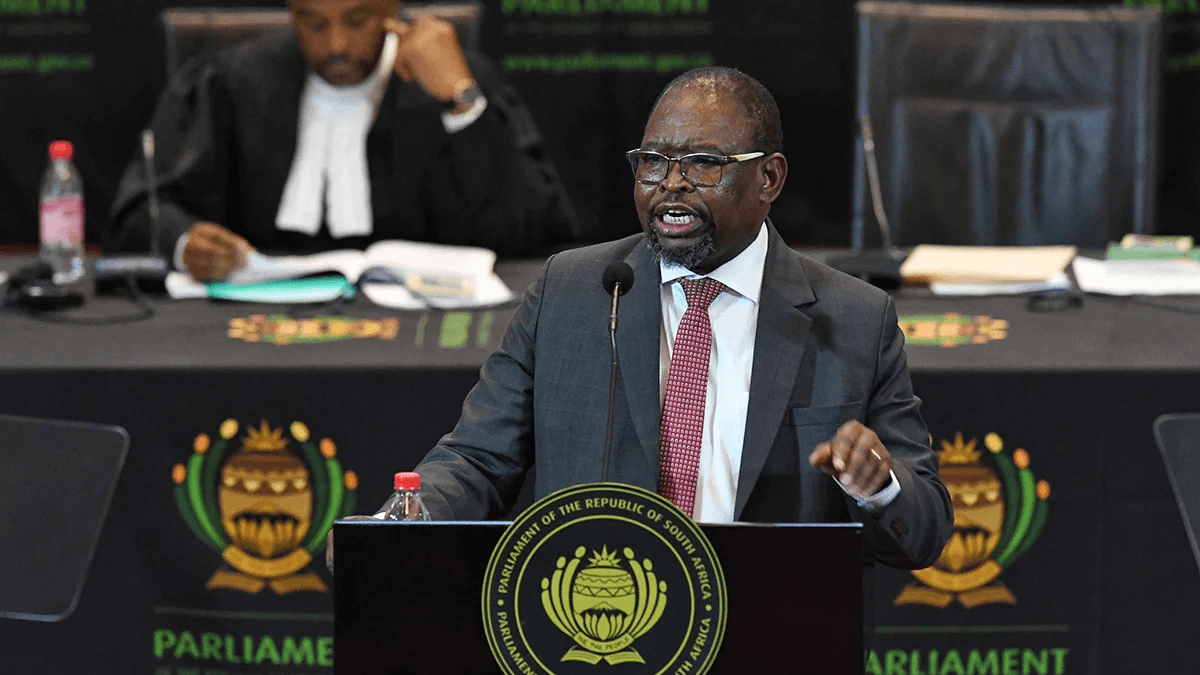
Finance Minister Enoch Godongwana will deliver the 2026 Medium-Term Budget Policy Statement (MTBPS), often called the mini-budget, in Parliament at 14:00 this afternoon, Wednesday, 21 October.
It comes at a tough time for South Africa’s economy. The Middle East war has pushed up oil prices, petrol has hit a record R30,25 a litre in Gauteng, unemployment has climbed to 33,6% and interest rates have started rising again. At the same time, Treasury is expected to have collected far more tax than planned. That gives the minister some room to move, and it puts him under pressure from opposition parties, unions and economists over how to use it.
When And Where Is The Mini-Budget?
- Date: Wednesday, 21 October 2026
- Time: 14:00
- Venue: Parliament, Cape Town
- Documents: The full MTBPS documents will be published on the National Treasury website, www.treasury.gov.za, today.
- How to watch: The speech is usually broadcast live on Parliament’s channels and by major television and radio news stations.
Members of the public can comment too. Parliament’s finance committees are accepting written submissions on the MTBPS until 12:00 on Monday, 26 October 2026.
What Is The Medium-Term Budget Policy Statement?
The MTBPS is government’s mid-year financial check-in. In February, the Finance Minister tables the main Budget, which sets out tax changes and spending plans for the year. In October or November, the MTBPS updates those plans. It shows:
- how the economy has performed, and revised growth forecasts
- how much tax has actually been collected compared with what was expected
- updated forecasts for the budget deficit and government debt
- any changes to spending plans, including adjustments to this year’s budget
- the direction government will take in next February’s Budget.
The mini-budget doesn’t usually announce major tax changes. Those are kept for February. But it can signal what’s coming and adjust spending for the current year.
ALSO READ: Fuel Price October 2026: Gauteng 95 Hits R30.25 As Fuel Prices Surge
The Economy The Minister Is Facing
| Indicator | Latest figure |
|---|---|
| Economic growth (Q2 2026) | GDP shrank by 0,2%, the first contraction after six quarters of growth |
| Official unemployment (Q2 2026) | 33,6%, up from 32,7% in Q1 |
| Youth unemployment (ages 15 to 34) | 47,4% |
| Unemployed people | About 8,5 million |
| Inflation (August 2026) | 4,4%, expected to go above 5% later this year |
| Repo rate | 7,25%, after a 0,25 percentage point hike on 23 September |
| Inland 95 petrol | R30,25 a litre, a record |
| Inland diesel (0,05% wholesale) | R31,95 a litre |
Growth Has Stalled
The economy shrank by 0,2% in the second quarter of 2026. That ended a run of six quarters of growth. Manufacturing fell by 1,8%, mining by 3,0% and trade, catering and accommodation by 1,9%.
In February, Treasury forecast growth of 1,6% for 2026. In June, Godongwana said Treasury was reassessing its numbers for the MTBPS because the Middle East conflict had “triggered sharp increases in energy prices”. The Reserve Bank has since cut its 2026 growth forecast to 1,2%, and economists widely expect Treasury to lower its forecast today.
Jobs Are Disappearing
The official unemployment rate rose to 33,6% in the second quarter. The number of unemployed people grew by 345 000 to about 8,5 million. Gauteng lost 22 000 jobs during the quarter. A separate Stats SA survey of formal businesses found that 95 000 jobs had been lost in the year to June 2026, mostly in manufacturing, business services and trade.
Inflation And Interest Rates Are Rising Again
Inflation was 4,4% in August. The Reserve Bank expects it to go above 5% later in 2026 and into early 2027 as higher fuel prices feed through the economy. Stats SA is due to release September’s inflation figure today. On 23 September, the Reserve Bank raised the repo rate by 0,25 percentage points to 7,25%, which means higher home loan and vehicle repayments for millions of households.
How The Middle East War Is Hitting South Africa
The conflict involving the US and Iran, and disruptions to oil shipments through the Strait of Hormuz, have caused the biggest fuel price shock South Africa has seen in years. Brent crude peaked at about $138 a barrel in April. It fell after a ceasefire in June, but traded above $100 again for much of September.
For South Africans, that has meant:
- Record petrol prices: inland 95 petrol has risen from R20,10 in February to R30,25 in October. Early data points to another increase in November.
- Higher transport and food costs, because diesel moves almost everything.
- Higher inflation and interest rates, which squeeze household budgets further.
Government cut the fuel levy by R3 a litre from April to June to soften the blow. Treasury estimated that relief cost about R17,2 billion in lost revenue, and it was fully phased out by 1 July.
What Economists Expect
A Tax Windfall
Despite weak growth, tax collections are running well ahead of target. This is mainly because of higher commodity prices, especially gold and precious metals, which boost mining company taxes.
- PSG chief economist Johann Els says the revenue overrun could reach R50 billion or more.
- Bank of America estimates revenue could beat budget assumptions by as much as R70 billion in 2026/27.
A Smaller Deficit And Lower Debt
In February, Treasury projected a budget deficit of 4% of GDP for 2026/27. Several economists now expect it to come in closer to 3,5%. Bank of America expects government debt to fall to about 77% of GDP this year, from 79% last year. The February Budget projected that debt would peak at 78,9% of GDP in 2025/26.
Caution About Spending The Windfall
Most economists expect a cautious, fiscally conservative mini-budget. Els says that because growth is weak and part of the windfall comes from commodity prices that may not last, Treasury is unlikely to build the full overrun into its future forecasts. Econometrix’s Azar Jammine says government has “a bit of leeway”, and the key question is how it uses the extra money.
Credit Rating Hopes
A strong fiscal update could support further credit rating upgrades. S&P upgraded South Africa in November 2025, and Fitch upgraded it to BB in June 2026. Moody’s and S&P are expected to give their next updates in late November, and Fitch in December. Bank of America sees a Moody’s upgrade as the most likely next move.
Pressure For Fuel Price Relief
The biggest political question going into today’s speech is whether government will use some of the windfall to bring down fuel prices.
- The R10 billion fuel relief bill: Parliament’s Standing Committee on Appropriations has adopted its report on the Second Special Appropriation Bill. The bill would move R10 billion to the Department of Mineral and Petroleum Resources “to stabilise fuel costs”. It still needs to pass the National Assembly. Committee chairperson Mmusi Maimane said citizens should “enter December with some relief”.
- ActionSA says the SARS revenue overrun “creates immediate fiscal space for a temporary reduction in the fuel levy”.
- The DA wants the Road Accident Fund levy, currently R2,25 a litre, removed from the fuel price through reform of the RAF.
- Trade union UASA has called for emergency relief, saying low- and middle-income workers carry the heaviest transport costs.
- The Concerned Citizens of South Africa has given government 14 days to cut fuel prices by 50%, or face a three-day national shutdown.
Treasury has been cautious. Godongwana has said the budget can’t protect motorists from every external price increase. Treasury has also pointed out that levy cuts come at a cost to public finances. Absa says any decision on temporary fuel levy relief will be “closely watched”.
Other Issues To Watch
- Growth forecasts: how far Treasury lowers its 2026 growth forecast, and what that means for future tax collections.
- Debt-service costs: interest on government debt was budgeted at 16,2% of total spending in 2026/27. That’s money that can’t go to services.
- The SRD grant: the R370 Social Relief of Distress grant has been extended to March 2027, reaching about 8,2 million people. Any signal on its future after that will be closely watched.
- Spending adjustments: any additional allocations for this financial year, including fuel relief, will show up in the Adjustments Appropriation Bill tabled with the MTBPS.
- Jobs and reform: how government plans to boost growth and employment, from infrastructure to energy and logistics reforms.
What Happens Next
Gauteng is South Africa’s economic hub, and its residents feel the pressure directly: inland fuel prices, long commutes, higher bond repayments and rising food costs. Today’s mini-budget won’t change your tax this year. But it could signal whether fuel relief is coming before December, how secure social grants are and how government plans to support jobs in a province that lost 22 000 jobs in the second quarter alone.
We’ll update this article with the key announcements once the minister has spoken.
- Today, after the speech: National Treasury publishes the full MTBPS documents and the Adjustments Appropriation Bill.
- 26 October 2026: deadline for public submissions to Parliament’s finance committees.
- 19 November 2026: the Reserve Bank’s next interest rate decision.
- Late November 2026: Moody’s and S&P credit rating reviews, followed by Fitch in December.
- February 2027: the main 2027 Budget, where any tax changes will be announced.
Frequently Asked Questions
What Time Is The Mini-Budget Speech Today?
Finance Minister Enoch Godongwana will deliver the Medium-Term Budget Policy Statement at 14:00 on Wednesday, 21 October 2026, in Parliament.
What Is The Difference Between The Budget And The Mini-Budget?
The main Budget in February sets out tax changes and spending plans for the year. The mini-budget, or MTBPS, is a mid-year update on the economy, tax collections, debt and spending plans. It also gives direction for the next Budget.
Will The Mini-Budget Reduce Fuel Prices?
That’s not yet known. Parliament is considering a bill to set aside R10 billion to stabilise fuel costs, and opposition parties and unions are calling for a temporary fuel levy cut. Treasury has been cautious about the cost of further relief.
Will Taxes Go Up In The Mini-Budget?
Major tax changes are normally announced in the February Budget, not the MTBPS. Economists expect a better-than-expected tax take this year, which reduces pressure for new taxes.
How Is The Middle East War Affecting South Africa’s Economy?
It has pushed oil prices sharply higher, leading to record fuel prices, higher inflation and a rise in interest rates. Treasury and the Reserve Bank have both signalled weaker growth as a result.
What Is South Africa’s Unemployment Rate?
The official unemployment rate was 33,6% in the second quarter of 2026, with youth unemployment at 47,4%.
