





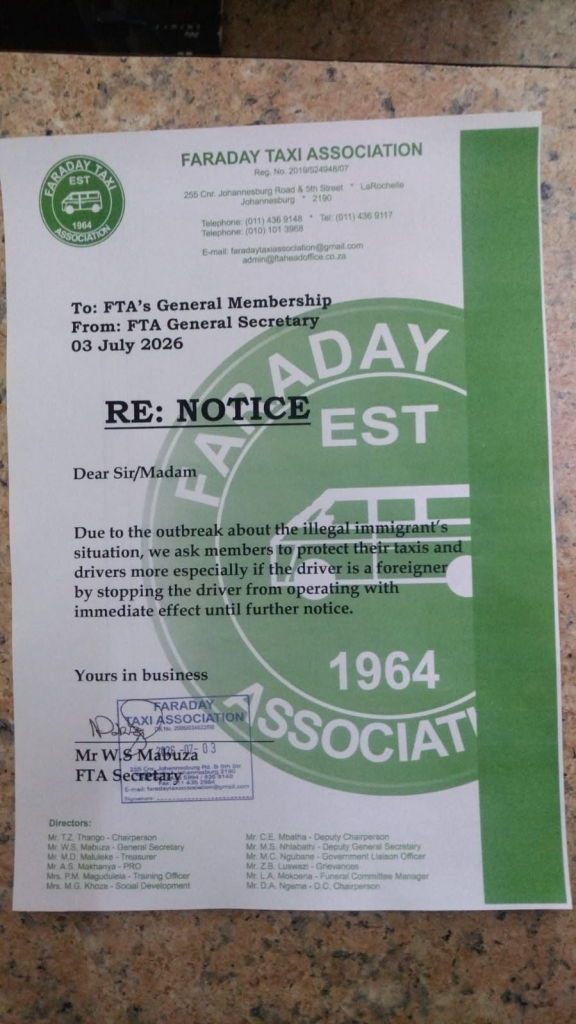
The Faraday Taxi Association has instructed members to suspend foreign-national taxi drivers and operators from duty until further notice, citing concern about taxi violence and heightened tensions following the 30 June anti-illegal immigration protests.
The instruction affects drivers and operators linked to the association in Johannesburg and comes as Gauteng transport authorities engage taxi industry representatives over licensing backlogs, illegal operations and violence in the sector. The association has not set a date for when the suspension will end.
The decision has raised questions about commuter access, the legal rights of workers and the responsibility of taxi associations and government to maintain safety without discrimination or unlawful exclusion.
Faraday Taxi Association Issues Suspension Notice
The Faraday Taxi Association, also known as the FTA, said foreign-national drivers and operators should stop operating immediately until further notice.
In a notice signed by general secretary W.S. Mabuza, the association called on members to protect their taxis and drivers, particularly where a driver is a foreign national.
The notice referred to the current “illegal immigrants’ situation” and the heightened tensions that followed the 30 June demonstrations.
The suspension was announced after the nationwide protests associated with the March and March movement, which called for stronger enforcement of immigration laws. The protests took place in several provinces, including Gauteng.
The FTA’s statement did not specify how many drivers or operators would be affected, which taxi routes may be affected or what conditions would need to be met before the suspension is lifted.
Gauteng Transport MEC Engages Taxi Industry
The announcement follows a recent visit by Gauteng MEC for Roads and Transport Kedibone Diale-Tlabela to the Faraday Taxi Association in Johannesburg.
According to the Gauteng Department of Roads and Transport, the engagement formed part of an effort to address internal industry processes, municipal delays and operational backlogs affecting taxi operators.
The department said the discussions also focused on ongoing taxi-related violence, licensing challenges and the growth of illegal and informal taxi ranks in high-density areas, including the Johannesburg CBD.
Diale-Tlabela said the department’s engagement programme was intended to allow operators to raise concerns directly with officials.
“This programme allows us to meet operators where they work, verify whether we are meeting their needs, and give them space to raise concerns,” the MEC said.
She also referred to low participation in the national taxi recapitalisation programme, saying the department was engaging the industry to understand barriers that may be affecting implementation.
Taxi Violence Remains a Major Concern
Taxi violence remains a serious concern in Gauteng, where disputes over routes, permits, ranks and operating rights can affect drivers, commuters and nearby businesses.
The FTA said its decision was linked to concern about the safety of taxis and drivers during the current period of tension. However, no official information has been released linking foreign-national taxi drivers to any specific incident of taxi violence.
The Gauteng Department of Roads and Transport has said it wants to work with taxi associations and municipalities to improve regulation and reduce illegal operations.
The department has also stressed the need for the taxi industry to operate as a stable and lawful public transport sector.
“Our responsibility is to ensure proper licensing, eliminate illegal operations, and create a safe, regulated environment for all,” Diale-Tlabela said.
Immigration Enforcement Is a Government Function
South African immigration law gives government agencies responsibility for verifying permits, visas and immigration status.
The Department of Home Affairs, the South African Police Service, the Border Management Authority and other authorised agencies are responsible for enforcement processes. Taxi associations, employers and members of the public do not have the authority to independently determine a person’s immigration status or carry out immigration enforcement.
Employers and operators may have legal obligations relating to work permits and employment compliance. However, labour law and constitutional protections also apply to workers, including protections against unfair discrimination.
The FTA notice does not state whether the suspension applies only to drivers whose documentation has not been verified or to all foreign-national drivers linked to the association.
This distinction may become important if the decision is challenged by affected workers, unions, transport organisations or government authorities.
What This Means for Gauteng Residents
For commuters, the immediate impact will depend on how widely the suspension is applied across Faraday Taxi Association routes and whether operators can maintain normal services.
The association has not indicated whether commuters should expect route changes, fewer taxis or altered operating hours. Residents who rely on affected routes may face uncertainty if drivers are removed from duty without replacement.
For foreign-national drivers and operators, the instruction could affect income and employment while the suspension remains in place.
For the wider taxi industry, the decision adds pressure on government, associations and municipalities to address safety concerns through lawful processes. It also raises questions about how taxi operators can protect drivers and commuters without creating blanket exclusions based on nationality.
The Gauteng Department of Roads and Transport may face calls to clarify its position on the suspension and whether it will engage the association on the effect of the decision on workers and commuters.
Frequently Asked Questions
What has the Faraday Taxi Association announced?
The association said foreign-national taxi drivers and operators linked to the FTA should be suspended from duty until further notice.
Why did the association suspend foreign-national drivers?
The FTA referred to safety concerns, taxi violence and heightened tensions following the 30 June anti-illegal immigration protests.
How long will the suspension last?
The association has not announced an end date or specified conditions for lifting the suspension.
Will taxi commuters be affected?
The impact will depend on how many drivers are affected and whether operators can maintain services on routes linked to the association.
Who is responsible for immigration enforcement?
Immigration enforcement is the responsibility of authorised government agencies, including Home Affairs, SAPS and the Border Management Authority.
What Happens Next
The Faraday Taxi Association has not provided further detail on its decision or whether it will review the suspension with government and industry stakeholders.
Attention is likely to turn to whether the Gauteng Department of Roads and Transport, labour authorities and taxi industry representatives engage on the safety concerns raised by the association, the effect on commuters and workers, and the legal basis for the instruction.
