




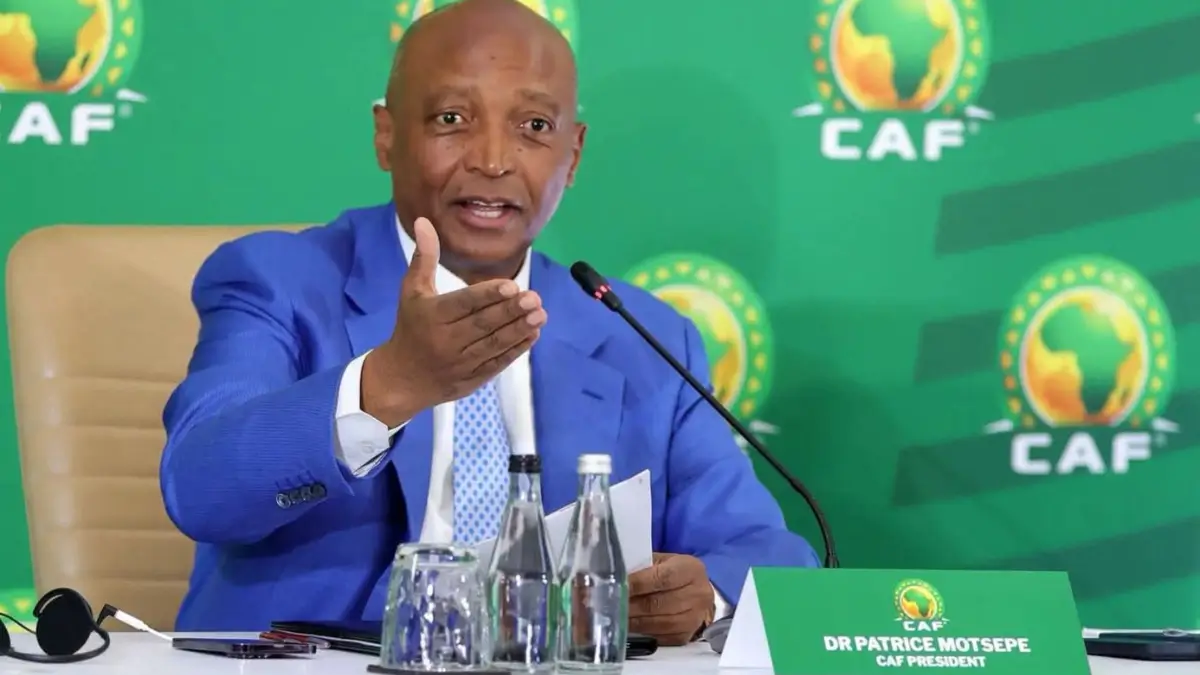
CAF President Patrice Motsepe says he remains confident that the 2027 Africa Cup of Nations will be successfully staged by Kenya, Tanzania and Uganda despite challenges linked to preparations for the tournament. Speaking at a media briefing in Johannesburg this week, Motsepe said the three host countries were continuing with infrastructure and organisational work ahead of the competition, which will run from 19 June to 17 July 2027.
The tournament will be the first AFCON jointly hosted by three countries, placing significant attention on stadium readiness, transport, accommodation and tournament operations across East Africa. CAF has already established an oversight structure with the three governments and football associations to monitor preparations.
Patrice Motsepe Acknowledges Challenges but Backs Host Nations
Motsepe did not dismiss concerns surrounding preparations, particularly the scale of infrastructure work still required before the tournament begins.
Speaking in Johannesburg, he said there were challenges but expressed confidence in the work being carried out by the governments of Kenya, Tanzania and Uganda.
“We have to have confidence in our people despite the challenges,” Motsepe said, adding that the tournament in East Africa could still be an “enormous success”.
Kenya has faced particular scrutiny over stadium construction and renovation projects, including work linked to major venues in Nairobi.
CAF has been meeting government and football officials from all three countries as preparations intensify. In May, Motsepe and officials from the host nations agreed to establish a PAMOJA Oversight Committee to help coordinate preparations and accelerate outstanding work.
AFCON Returns to East Africa After More Than 50 Years
The 2027 tournament will mark AFCON’s return to East Africa for the first time since Ethiopia hosted the competition in 1976.
It will also be the first edition in tournament history to be jointly staged by three countries.
CAF has confirmed that the opening match will take place on Saturday, 19 June 2027, with the final scheduled for Saturday, 17 July.
The host country for the opening match and final has not yet been confirmed. CAF has also said that final stadium and host city arrangements will be announced after further consultations with the three local organising committees and governments.
The tournament will feature 24 teams.
Kenya, Tanzania and Uganda qualify automatically as co hosts, while the remaining places will be decided through the qualifying campaign.
Bafana Bafana Drawn With Kenya in AFCON Qualifying
South Africa will be directly involved in the road to AFCON 2027 after being drawn in Group D alongside Guinea, Kenya and Eritrea.
Because Kenya qualifies automatically as a host nation, only the highest placed non host team in the group will qualify for the finals.
That makes South Africa’s qualifying campaign particularly significant.
CAF confirmed that the qualifiers will be played across three international windows:
- Matchdays 1 and 2 from 21 September to 6 October 2026
- Matchdays 3 and 4 from 9 to 17 November 2026
- Matchdays 5 and 6 from 22 to 30 March 2027
The format means South Africa will need to finish ahead of Guinea and Eritrea in the group standings to secure qualification, regardless of Kenya’s final position.
For Gauteng supporters, the qualifying campaign will be closely watched after Bafana Bafana’s improved performances on the international stage.
CAF Opens Bidding for Future AFCON Tournaments
While preparations continue for 2027, CAF has also started planning the future hosting cycle of the competition.
The governing body has invited its 54 member associations to submit bids to host AFCON tournaments in 2028, 2032 and 2036.
CAF said the bidding process will be evaluated under a framework designed to assess technical, financial, legal and infrastructure requirements.
The 2028 tournament will also form part of a wider change to CAF’s national team calendar.
CAF has indicated that senior men’s continental competitions will be organised annually except in FIFA World Cup years, with further details on future competition scheduling still to be announced.
Motsepe Says African Football Must Aim Higher
Motsepe’s comments on AFCON 2027 came during a broader media engagement in Johannesburg in which he also addressed the future of African football.
He said the continent should take greater confidence from the performances of African national teams at the 2026 FIFA World Cup.
South Africa was among the African teams that advanced beyond the group stage, while Morocco and Egypt reached the quarterfinals.
Motsepe said African countries should now set higher targets at future World Cups, including competing for semifinal and final places.
He also indicated that CAF plans to hold a conference to assess what African teams learned from the 2026 tournament and identify areas for improvement across coaching, preparation and administration.
The comments reflect CAF’s wider push to improve the competitiveness of African national teams beyond continental competitions.
AFCON 2027 Preparations Remain Under Scrutiny
Despite Motsepe’s confidence, tournament readiness will remain an important issue over the coming months.
Hosting across three countries creates additional logistical demands compared with a single nation tournament.
Teams, supporters, officials and broadcasters will need to move between multiple cities and national borders, placing pressure on transport systems, accommodation and tournament coordination.
CAF has not yet confirmed the final list of stadiums that will stage matches.
The governing body has said it is continuing consultations with local organising committees and governments before announcing final venue allocations.
The success of the tournament will therefore depend on whether infrastructure projects are completed on time and whether the three host nations can operate as one coordinated tournament structure.
What This Means for Gauteng Residents
For Gauteng football supporters, AFCON 2027 has direct relevance because South Africa is competing for qualification.
Bafana Bafana’s Group D campaign will determine whether the national team travels to East Africa for the tournament.
Matches involving South Africa during the qualifying windows could also bring international football to Gauteng venues, depending on SAFA’s venue selections.
The tournament also has a strong South African leadership connection through Motsepe, who has served as CAF President since 2021 and was re elected for a second term in 2025.
His current term runs until 2029.
For local supporters considering travelling to East Africa in 2027, final venue details, ticketing information and travel arrangements are still to be confirmed.
Frequently Asked Questions
When Is AFCON 2027?
The Africa Cup of Nations will run from Saturday, 19 June to Saturday, 17 July 2027.
Which Countries Are Hosting AFCON 2027?
Kenya, Tanzania and Uganda will jointly host the tournament. It will be the first AFCON co hosted by three countries.
Has CAF Confirmed the Stadiums for AFCON 2027?
No. CAF has confirmed the tournament dates but has not yet announced the final stadium and host city list.
Who Will South Africa Face in AFCON 2027 Qualifying?
Bafana Bafana have been drawn in Group D with Guinea, Kenya and Eritrea. Kenya qualifies automatically as a co host, meaning only the highest placed non host team in the group will also qualify.
When Do AFCON 2027 Qualifiers Start?
The first two matchdays will be played between 21 September and 6 October 2026. The final qualifying matches are scheduled for March 2027.
East Africa Enters Crucial Phase of AFCON Preparations
AFCON 2027 will be one of the most complex editions of the tournament to stage, with three countries sharing hosting responsibilities for the first time.
Motsepe has acknowledged that challenges remain, but CAF is continuing to work with Kenya, Tanzania and Uganda through oversight structures and government level coordination.
Attention will now shift increasingly towards infrastructure completion, final venue confirmation and the qualifying campaign beginning later in 2026.
For South Africa, the immediate focus is clear. Bafana Bafana must navigate a competitive qualifying group to secure their place at a tournament that will mark the return of Africa’s biggest football competition to East Africa after more than five decades.
