




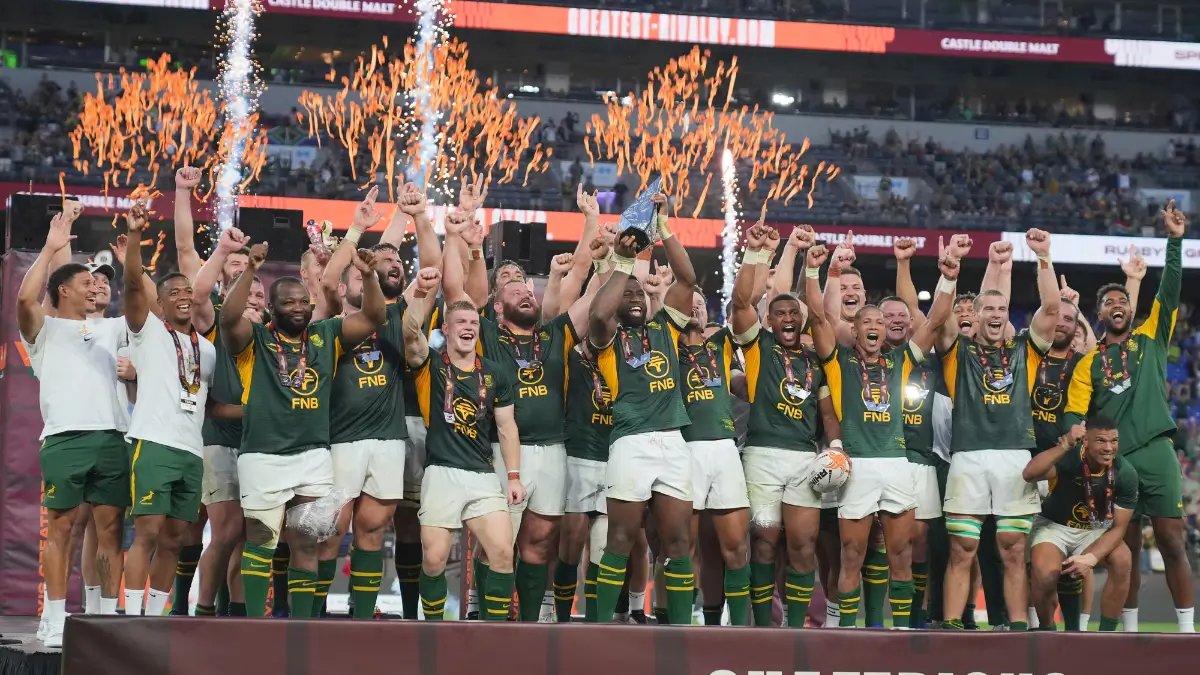
The Springboks have won the inaugural Rugby’s Greatest Rivalry series 3-1 after beating the All Blacks 43 28 in Baltimore on Saturday, completing a turnaround that began after South Africa lost the opening Test at Ellis Park. The world champions won three consecutive matches against New Zealand in Cape Town, Soweto and the United States to secure the four Test series.
Springbok coach Rassie Erasmus said South Africa was proud to have been part of the new series regardless of the final result, while Damian Willemse said the team’s biggest achievement was how its performances improved from one Test to the next.
ALSO READ:Thabo Cele Linked With Mamelodi Sundowns After Kaizer Chiefs Exit
Springboks recover from Ellis Park defeat
The series started badly for South Africa in Johannesburg, where New Zealand claimed a 33-16 victory at Ellis Park.
The result ended the Springboks’ 12 Test winning run and gave the All Blacks the early advantage in the four match series.
South Africa responded in Cape Town with a 33- 26 victory, levelling the series before the teams returned to Gauteng for the third Test.
At Soweto, the Springboks won 29- 24, giving them a 2- 1 advantage before the final Test in Baltimore. New Zealand needed to win the final match to level the series.
Instead, South Africa produced its strongest result of the series.
How the four Tests unfolded
| Test | Venue | Result |
|---|---|---|
| First Test | Ellis Park, Johannesburg | All Blacks won 33- 16 |
| Second Test | Cape Town | Springboks won 33-26 |
| Third Test | Soweto | Springboks won 29-24 |
| Fourth Test | Baltimore, United States | Springboks won 43- 28 |
| Series result | Springboks won 3-1 |
Willemse said the progression across the four matches was an important part of the result.
He acknowledged that the Springboks were below their own standards in the first Test, particularly at scrum time and when attempting to convert opportunities.
As the series progressed, however, South Africa improved.
“We built our game and got better,” Willemse said, describing that improvement as one of the aspects the team was most proud of.
Boks pull away in Baltimore
The final score in Baltimore did not reflect how close the deciding Test remained for much of the match.
South Africa led 17- 14 at half time after the All Blacks scored a converted try shortly before the break.
The Springboks responded strongly after half time, scoring two early tries to open a larger advantage.
New Zealand remained in the contest before South Africa eventually pulled clear later in the second half. The Boks finished with six tries compared with four from the All Blacks.
Willemse said the game only began moving decisively in South Africa’s favour around the final quarter.
The result completed a run of three consecutive victories over New Zealand after the opening defeat in Johannesburg.
Kurt Lee Arendse try proves pivotal
Erasmus identified Kurt Lee Arendse’s individual try as one of the decisive moments in the final Test.
Arendse collected a loose ball inside South Africa’s half before breaking through the New Zealand defence and reaching the try line.
Erasmus said the score helped the Springboks create separation at a stage when the match remained closely contested.
“Kurt Lee started burning guys,” Erasmus said after his 100th match in charge of the Springboks.
The coach also noted that Arendse had been working through a difficult period physically and mentally, including concussion issues.
Erasmus described the try as pivotal because, until that stage, either team remained capable of taking control of the Test.
Erasmus’ say’s series was bigger than the result
Despite South Africa winning three of the four Tests, Erasmus said the significance of Rugby’s Greatest Rivalry extended beyond the final series score.
The 2026 series marked the first proper tour between the Springboks and All Blacks since New Zealand won a three-Test series in South Africa in 1996.
Erasmus said he supported the concept when it was proposed because of the history between the two rugby nations.
The coach also pointed to the discussion generated throughout the series, including debates around tactics and scrummaging.
“I think it’s great for the game,” Erasmus said.
He added that he would still have viewed the series as successful had New Zealand won in Baltimore and forced a 2-2 draw.
More than 68 000 attend Baltimore Test
The final Test also took the Springboks and All Blacks beyond their traditional rugby markets.
More than 68 000 spectators attended the match at M&T Bank Stadium in Baltimore, according to reporting supplied from the event. Many South African supporters attended the match and supported the Springboks throughout the Test.
Erasmus and captain Siya Kolisi both highlighted the South African support they encountered in the United States.
Kolisi said the team saw supporters wearing green jerseys before arriving at the stadium and had also encountered fans at the team hotel and during the build up to the match.
The United States will host the men’s Rugby World Cup in 2031, making major international fixtures in the country increasingly relevant as rugby prepares for the tournament.
Springboks see opportunity for rugby in United States
Erasmus also highlighted the sporting infrastructure the Springboks experienced during their stay in Baltimore.
He said the team was impressed by the facilities and organisation available to professional sports teams in the United States.
Both Erasmus and Kolisi said they hoped rugby would continue growing in the country before the 2031 World Cup.
Kolisi said rugby’s physical nature could appeal to American sports audiences, while Erasmus said greater understanding of the sport’s laws could help new supporters follow the game.
For the Springboks, the Baltimore Test ultimately provided both a series decider and an opportunity to play one of rugby’s biggest international fixtures in a developing market.
What This Means for Gauteng Residents
Gauteng played an important role in the inaugural Rugby’s Greatest Rivalry series.
The series began at Ellis Park in Johannesburg, where the Springboks suffered their only defeat, before returning to the province for the third Test in Soweto.
That Soweto victory proved critical. The 29 – 24 result gave South Africa a 2 – 1 series lead before the teams travelled to Baltimore.
The four Test sequence also showed the progression Willemse highlighted after the final match. South Africa went from a 17 point defeat at Ellis Park to victories in Cape Town and Soweto before producing its biggest winning margin of the series in Baltimore.
For Gauteng rugby supporters who attended the Johannesburg and Soweto Tests, the province hosted both the beginning of South Africa’s setback and a crucial stage of its recovery.
Frequently Asked Questions
Who won Rugby’s Greatest Rivalry in 2026?
The Springboks won the inaugural series 3 – 1, beating the All Blacks in Cape Town, Soweto and Baltimore after losing the opening Test at Ellis Park.
What was the Springboks vs All Blacks Baltimore score?
South Africa beat New Zealand 43 – 28 in the final Test in Baltimore.
What happened at Ellis Park?
The All Blacks won the opening Test 33 – 16 at Ellis Park in Johannesburg, ending the Springboks’ 12 Test winning streak.
What was the score in Soweto?
The Springboks beat the All Blacks 29- 24 in Soweto, taking a 2 – 1 series lead ahead of the Baltimore decider.
Why was the Baltimore Test significant?
The match decided the inaugural Rugby’s Greatest Rivalry series and attracted more than 68 000 spectators in the United States, which will host the men’s Rugby World Cup in 2031.
Springboks finish the series with three straight wins
The 43-28 victory in Baltimore completed a significant turnaround for South Africa after the opening defeat at Ellis Park.
The Springboks responded by winning three consecutive Tests, with Willemse pointing to the team’s improvement throughout the series rather than a single performance as a key source of satisfaction.
For Erasmus, the result also represented something broader. The first Rugby’s Greatest Rivalry series revived the touring history between South Africa and New Zealand while taking its deciding Test to the United States.
The Springboks leave the inaugural series as 3-1 winners, with Gauteng having hosted two important chapters of the four-Test contest.
